
GRE Pipes & Fittings
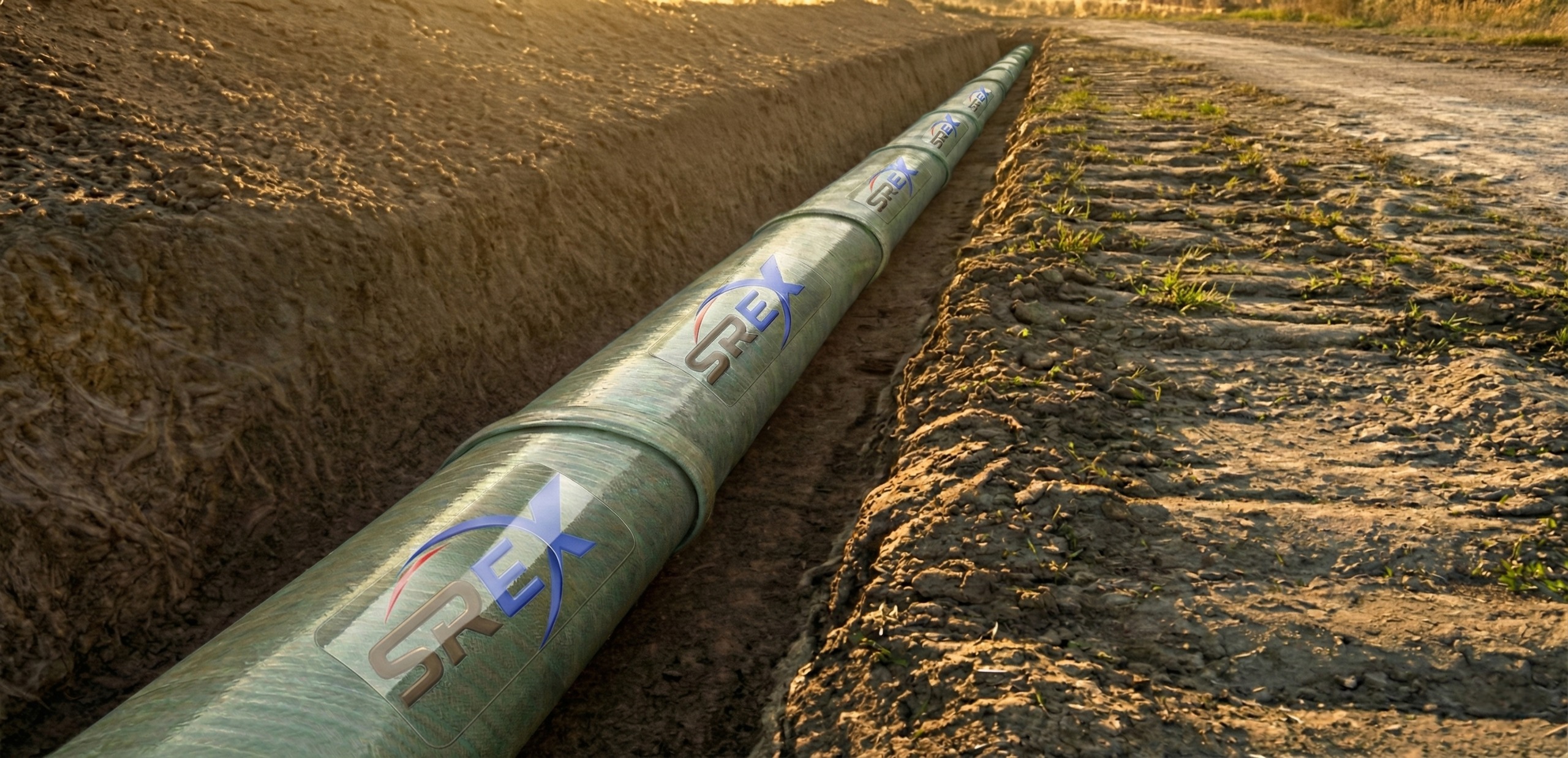
Glass Reinforced Epoxy (GRE) piping systems are designed for applications requiring high mechanical strength, elevated pressure capability and reliable thermal performance. In simple terms, gre pipe meaning and gre pipes meaning refer to high-performance epoxy-based composite systems. Unlike standard GRP systems that use polyester or vinyl ester resins, GRE piping is manufactured using epoxy resin, which provides a dense, cross-linked matrix with exceptional structural stability, making it a preferred gre material pipe solution.
SREX Composites supplies gre pipes and gre fittings, including a complete range of gre pipe fittings and gre pipes and fittings for industries where corrosion resistance alone is not enough and where higher strength, temperature tolerance and long-term endurance are essential. These systems are widely used in offshore platforms, marine piping, fire-water networks, oil & gas utilities, desalination plants and industrial cooling water circuits. Our expertise also covers gre and grp, including integrated gre grp and gre grp pipe systems.
GRE piping offers dependable operation in environments that expose metallic pipelines to rapid corrosion, erosion and system degradation. The combination of epoxy resin and controlled filament-wound glass reinforcement ensures predictable and long-lasting performance in mission-critical systems such as gre pipeline, gre pipework, advanced grve piping, and globally recognized systems like nov gre pipe.
Engineering Characteristics of GRE Systems
Applications of GRE Piping
GRE Piping Performance Advantages
GRE Applications in Marine, Offshore & Industrial Markets
GRE Fittings & System Components
Joining Options for GRE Pipes
Engineering Characteristics of GRE Systems
Epoxy Resin Matrix
GRE systems use epoxy resin as the binding matrix, which defines the gre pipe material and offers:
- High tensile and compressive properties
- Excellent resistance to micro-cracking and fatigue
- Very low water absorption
- Flame retardant performance when formulated for fire-water service
Filament-Wound Reinforcement Structure
Mechanical properties are achieved through:
- Precisely oriented glass fibers
- High hoop strength for pressure containment
- Controlled axial strength for bending and thrust loading
- Improved resistance to surge pressure and water hammer
Temperature & Pressure Stability
GRE pipes deliver stable performance under continuous high-temperature operation and high internal pressure — conditions where conventional GRP falls short.
Lightweight Advantage
High strength-to-weight ratio improves handling, supports efficient gre pipe installation, and reduces infrastructure load.
Applications of GRE Piping
GRE pipes are widely utilized in demanding operational environments such as:
- Fire water networks (onshore and offshore)
- Oil & gas flowlines, utility lines, produced water and injection lines
- Marine deck piping and seawater transport systems
- Desalination intake and outfall pipelines
- Cooling water systems in industrial and power plants
- District cooling systems
- Petrochemical and refinery utility piping
- Water disposal and treatment facilities
The material’s resilience and low corrosion potential make GRE an excellent replacement for steel in locations where humidity, saltwater and chemicals shorten metallic pipeline life.
GRE Piping Performance Advantages
- High pressure rating (up to 64 bar and project-specific higher classes)
- Superior performance under cyclic pressure and hydraulic shock
- Excellent chemical resistance toward seawater, brine and process utility fluids
- Extended service life with minimal maintenance
- Non-conductive and spark-free — ideal for electrical hazard zones
- No internal scaling or corrosion-related flow loss
- Rapid installation with adhesive joints, lamination joints or flanged systems
GRE Applications in Marine, Offshore & Industrial Markets
GRE systems are specially suitable for:
- Offshore platform piping
- Deck wash, ballast water and cooling water lines
- Produced water and formation water systems
- Seawater lift systems
- Utility networks in oil and gas plants
- Tank farms and terminal facilities
Epoxy systems ensure long-term reliability even under continuous vibration, temperature variations and exposure to salt-laden environments.
GRE Fittings & System Components
To support total system performance, SREX Composites manufactures a complete range of GRE fittings, including gre fittings and gre pipe fittings such as:
- gre elbow, including gre 90 elbow and gre 90 degree elbow, along with gre 45 elbow and gre 45 degree elbow
- gre bend, including gre 90 bend and gre 90 degree bend, as well as gre 45 bend and gre 45 degree bend
- gre tee, including gre equal tee and gre unequal tee
- gre cross
- gre reducer, including gre concentric reducer and gre eccentric reducer
- gre flange, including gre full face flange and gre s off flange
- gre stubend, gre stubend flange, and gre stubend with loose flange
- gre blind flange
- gre end cap
- gre puddle flanges
- gre lamination kit
Each fitting is produced to match the mechanical and thermal properties of GRE pipe to maintain uniform system integrity across all gre pipes and fittings systems.
Joining Options for GRE Pipes
- Adhesive-Bonded Joints – high-strength structural bonding
- Butt & Wrap / Lamination Joints – for critical or high-pressure applications
- Flanged Joints – for pump houses, valves, equipment and inspection points
GRE eliminates hot work requirements, making installation safer and faster, particularly in offshore zones, ensuring efficient gre pipe installation.
Design Standards & Compliance
GRE systems from SREX Composites comply with:
- ISO 14692 (GRE systems for oil & gas services)
- ASTM D2310 / D2992 / D2996
- DIN 16965 / 16966
- AWWA C950
- API & ABS requirements
- PS 15-69
Compliance ensures structural predictability, corrosion resistance and validated long-term performance.
Comparison Between GRE & GRP
Feature | GRE (Glass Reinforced Epoxy) | GRP (Glass Reinforced Plastic) |
Resin Type | Epoxy | Polyester / Isophthalic |
Temp & Pressure | Higher | Moderate |
Mechanical Strength | Higher | Good |
Chemical Resistance | Very High | High |
Typical Use Cases | Offshore, fire-water, O&G, desalination | Standard industrial corrosion service |
Cost | Higher | Lower |